About Literacy for Older Students
The literacy needs of older students, most especially those who have fallen behind, are simply not the same as young beginner readers.
All students, including the most able, need their current level of skill extended.

For those who struggle with any aspect of literacy, confidence, engagement and curiosity have usually taken a knock and need building.
Most struggling students have some phonics knowledge, albeit patchy, but lack the skills to effectively apply this knowledge to decoding and spelling. The emphasis needs to be on skill building rather than more and more phonics knowledge to ‘plug the gaps’.
Entrenched compensating strategies, especially guessing at words, need to be overridden.
Students who have fallen behind need to catch up, meaning gaining several years of achievement in one year in decoding and spelling, comprehension and writing.
This must work for all students in a mixed ability classroom with one teacher.
It can and must be done.
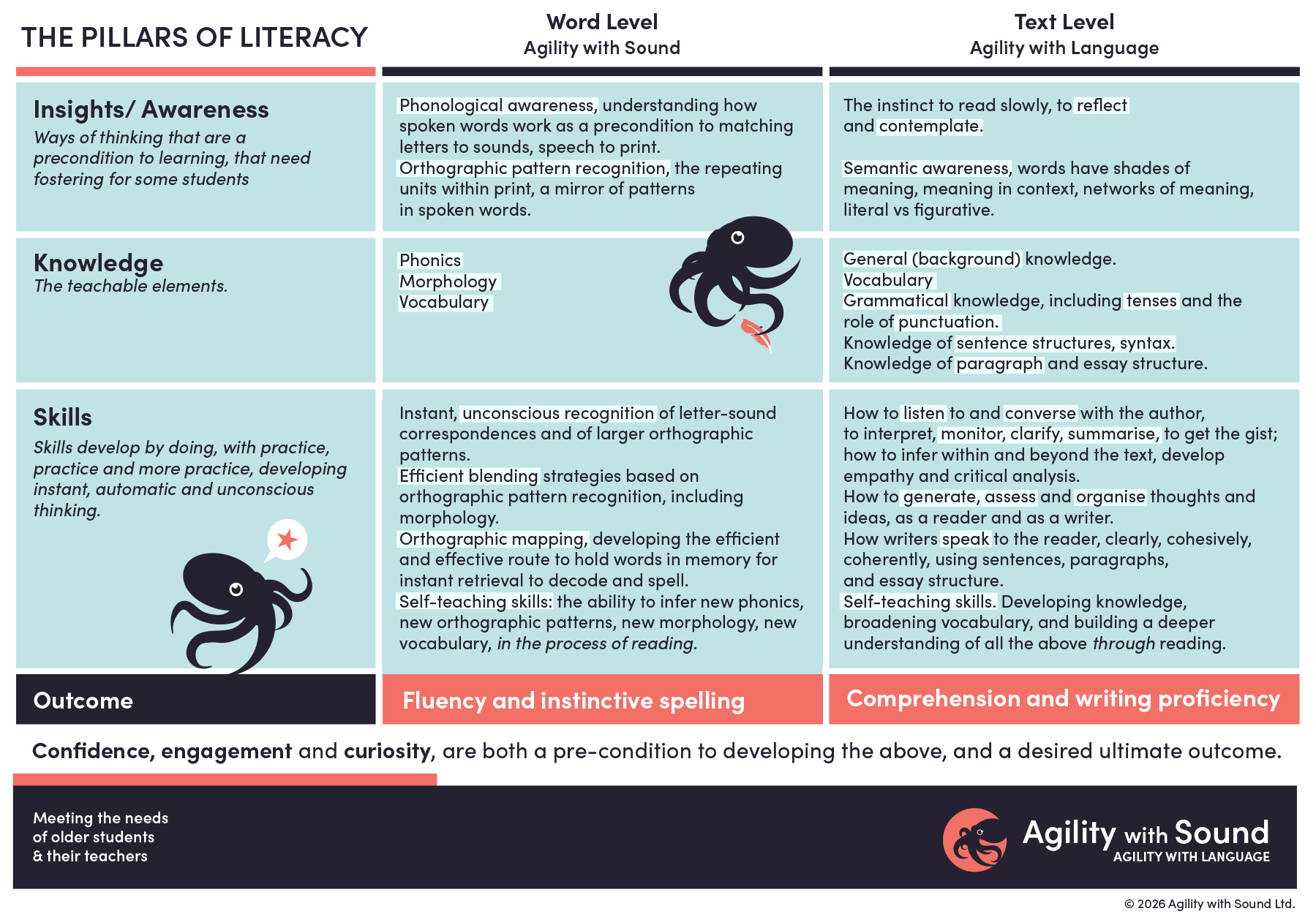
How to use The Pillars of Literacy chart
How competent students process and remember words to decode and spell
Dealing with long words
Spelling makes Sense, (mostly)
Rules? What rules?
Building comprehension, inferencing skills and vocabulary
Why an Octopus?
Octopuses (it’s a Greek word; this is the plural) fascinate me. Each arm has a mini brain at its tip, each able to gather and then independently process sensory information and send the result to the main brain in its head. For me, this is a metaphor for the multi-faceted thinking that needs to happen in all aspects of literacy: comprehending text, writing a sentence, assessing the specific connotation of a word, structuring a paragraph and so much more.
The common ancestor of an octopus and us is a tiny flat worm that existed 750 million years ago. The octopus’s huge intelligence has evolved independently. That blows my mind.