
A Structured Approach
Decodable books in digital format that are appropriate for older students make up the reading component of the Comprehendit resource.
As students read, they press buttons to hear the author speaking to the reader, guiding them through the thinking to comprehend, most especially building the skills to infer the meaning of unfamiliar vocabulary and to make inferences within and beyond the text.
This is followed for many titles by a heavily scaffolded writing assignment, requiring students to think about the text from another point of view.
Focus on decoding cvc words, s suffix, and double final consonant (toss, well, add)
| Title | Phoneme | Fiction, Non-f, N-f as story | Word count | Senior, Junior, All |
| Gas! | cvc | F | 228 | All |
| A Nap in the Sun | cvc | F | 285 | All |
| Rat gets Fat | cvc | F | 294 | All/ J |
| Gus the Pup | cvc + s suffix | F | 307 | All/ J |
| The Rag Pet | cvc + s suffix | F | 382 | All /J |
| Wag Wag | cvc + s suffix | F | 188 | All/ J |
| Go Sam Go | cvc + s suffix | F | 335 | All / J |
| Bugs in the Jam | cvc + double final consonant | F | 341 | All |
| Nan is O.K | cvc + double final consonant | F | 284 | All/ J |
| Mum’s Big Mess | cvc + double final consonant | F | 219 | All |
| A Kip in the Sun | cvc + double final consonant | F | 305 | All |
| Yum said Mum | cvc + double final consonant | F | 326 | All |
| My Bus | cvc + double final consonant | F | 562 | All/ S |
| A Tad | cvc + double final consonant | F | 233 | All |
| A Monster Problem | cvc + double final consonant | F | 556 | All |
| Rot in a Log | cvc + double final consonant | F | 661 | All/ S |
| A Mix Up | cvc + double final consonant | F | 728 | All/ S |
| For my Kids | cvc + double final consonant | F | 528 | All/ S |
| A Pet for Todd | cvc + double final consonant | F | 682 | All/ S |
| To Get to my Job | cvc + double final consonant | F | 740 | All/ S |
There are no writing assignments at this level. The illustration activity requires students to visualise their reading, to make basic inferences. Stick figures are acceptable.
Code:
All: appropriate for all ages
All/J: especially suited to younger students, ages 6 – 8
All/ S: especially suitable for older students
Focus on decoding cvc words, s suffix, and double final consonant (toss, well, add)
| Title | Phoneme | Fiction, Non-f Non-f as story |
Word count | Senior, Junior, All | Writing |
| A Bad Vet | th | F | 474 | All | 1 |
| Jess the Cat | th | F | 543 | All/ J | 1 |
| Into the Mud | th, sh, ch | F | 1096 | All | 1 |
| Cob and Sod | th, sh, ch | F | 1169 | S | 1 |
| Pepper in the Batter | Adds ing, ed, er suffixes | F | 716 | All | |
| Nag Nag | Adds ing, ed, er suffixes | F | 775 | All | 1 |
| A Winner | Adds ing, ed, er suffixes | F | 744 | J | |
| Polly and the Gas Man | ing, ed ,er and y suffixes | F | 1019 | All | 2 |
| A Pet Fox | ing, ed ,er and y suffixes | S 1* | 739 | All | 2 |
| Pig and Dog | ing, ed ,er and y suffixes | F | 719 | All/ J | |
|
The Problem of a Soccer Mad Dad |
ing, ed ,er and y suffixes | F | 905 | All/ S | 1 |
| Josh and his Bus | ing, ed ,er and y suffixes | F | 413 | All/ J | 1 |
| Sam and the Piglet | ing, ed ,er and y suffixes | F | 602 | All | 1 |
| My Big Rig | ing, ed ,er and y suffixes | F | 823 | All | |
| The Illness of Tilly the Pig | ing, ed ,er and y suffixes | S 2* | 893 | All/ S | 1 |
| When a Mozzy Bit Me | ing, ed ,er and y suffixes | N | 908 | All/ S | 1 |
|
Riff-Raff and Fuddy-Duddy |
ing, ed ,er and y suffixes | F | 905 | All/ S | 1 |
1* The behaviour of foxes, told through the challenges of attempting to keep one as an indoor pet.
2* A true account of one family’s experiences keeping kune kune pig
Level 2 writing.
This level introduces the concept of a paragraph. Paragraphs are simple: advantages in one paragraph, disadvantages in the next; before and after, and the like. But before they get to this, most students will need to come to grips with sentence structure. We strongly recommend working through the first sections of The Sentence Book, up to the section on compound sentences. Some students will need to spend a term or more coming to grips with basic sentence structure before they are ready to advance.
Even though these books are very basic decoding, many students will need to start here. Students who have advanced decoding skills but whose comprehension has not developed apace should start here, learning basic comprehension ways of thinking. In general, easy, effortless, unconscious decoding means the student can dedicate most or all of their cognitive energy to comprehension.
In addition, students who have not yet learnt to use paragraphs effectively should start their writing journey at this level.
Some students will need to work through most of the assignments presented here. Others will grasp the concepts quickly and will soon be able to make a start of the assignments that relate to the level 4 and 5 books.
Focus on ck, more simple suffixes
| Title | Phoneme | Fiction Non-f Non-f as story |
Word count | Senior, Junior, All | Writing |
| The Old Tom Cat | ay | F | 282 | J | |
| The Tin and Box Man | ay | F | 713 | All/ J | 1 |
| Stuck | ck; le | F | 604 | All/ J | |
| Cop and Robber | ck; ay | F | 657 | All | 1 |
| A Hat for the Rugby | ck; ay and y as in my | F | 642 | All/ S | 2 |
| The Rock Cutters | ck; ay, -all words | F | 828 | All/ S | 1 |
| All for a Better Shell | ck; le, en suffixes | N | 1375 | All/ S | 1 |
| Rats! | ck; ay, y as in my, ow; le and led | F | 571 | All/ J | |
| A Letter in a Bottle | ck; le, en suffixes | S 1* | 1001 | All/ S | 1 |
| Mr. Ducket’s Ferret | ck; le, et, en suffixes | F | 1147 | All/ S | 1 |
|
Picking up Kitty |
ck; le, et, en suffixes | F | 874 | All | 1 |
|
A Spy in the Colony |
ck; le, et, ly suffixes | S 2* | 1689 | All/ S | 1 |
| A Shipwreck | ck, -all words; le, et, en suffixes | F | 1297 | All/ S | 1 |
| Fishing for Cod | Ck; le, et, en suffixes | S 3* | 1403 | S | 1 |
1* The true story of a stowaway on Captain Cook’s vessel but imagined from the stowaway’s point of view. Details the fears of many sailors who believed the world was flat.
2* Based on a scientific paper about the threats to an endangered colony of gulls, and the role of rabbits in that threat. Told from the point of view of a gull chick, who becomes a spy to discover the problem of rabbits.
3* A true account of the collapse of the cod fishery in the North Atlantic, as told through the stories of several generations of one family of fishermen.
Level 3 writing
This level continues to develop the concept of a paragraph. The books are on more sophisticated themes than in level 2. Paragraphs in the writing assignments are basic and heavily scaffolded. But before they get to this, most students will need to come to grips with sentence structure. We strongly recommend working through the first sections of The Sentence Book, up to and including the section on compound sentences. Some students will need to spend a term or more coming to grips with basic sentence structure before they are ready to advance.
Even though these books are very basic decoding, many students will need to start here. Students who have advanced decoding skills but whose comprehension has not developed apace could start here, learning basic comprehension ways of thinking. In general, easy, effortless, unconscious decoding means the student can dedicate most or all of their cognitive energy to comprehension.
In addition, students who have not yet learnt to use paragraphs effectively but need more sophisticated reading material could start their writing journey at this level.
Some students will need to work through most of the assignments presented here. Others will grasp the concepts quickly and will soon be able to make a start of the assignments that relate to the level 4 and 5 books.
Focus on initial blends and simple suffixes
| Title | Phoneme | Fiction, Non-f, Non-f as story |
Word count | Senior, Junior, All | Writing |
| My Gran | Initial blends | F | 714 | All | 2 |
| Griff and his Sled | Initial blends | F | 997 | All | 1 |
| The Maths Test | Initial blends, ay, ow and y as in my | F | 752 | All | 1 |
| Dilly Duck | Initial blends, introduces ng | S | 1549 | All | 1 |
| Little Red gets Cunning | Initial blends; ng | S | 940 | J | |
| Getting Dinner | Initial blends; ng | F | 749 | All | |
| Chicken Licken | Initial blends | F | 484 | J | |
| Rugby | Initial blends, y as in my | S | 456 | All | |
| Little Butterfly | Initial blends; y as in my | S 4* | 663 | All | 1 |
| A Trip to the Rugby | Initial blends, ar phoneme | F | 195 | J | |
| Party in the Dark | Initial blends, ar, ng phonemes | F | 662 | All | 1 |
| Daddy Long Legs | Initial blends, ar, ng phonemes | N | 1169 | All/ S | 1 |
| A Frog Pet | Initial blends, ar, ng phonemes | S 5* | 1109 | All | 1 |
| The Starfish | Initial blends, ar, ng phonemes | N | 1014 | All/ S | |
| The Battles of an Arctic Fox | Initial blends, ar, ng phonemes | N | 1351 | All/ S | 2 |
| Pufferfish | Initial blends, ar, ng phonemes | N | 1225 | All/ S | 1 |
| The Little Chick | Initial blends, ar, ng phonemes | F | 567 | All | |
| The Ant and the Cricket | Initial blends, ar, ng phonemes | F | 916 | All | |
| Mr. Rat and Mr. Frog | Initial blends, ar, ng phonemes | F | 790 | All | |
| I am a Tracker | Initial blends, ar, ng phonemes | S 6* | 2178 | All/ S | 1 |
| How they Play Cricket | Initial blends, ar, ng phonemes | N | 2448 | All/ S | |
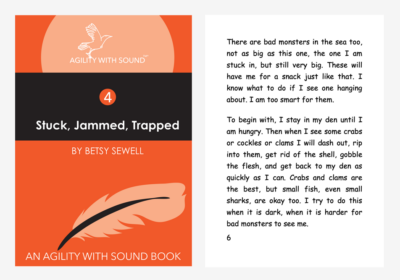
| Stuck, Jammed, Trapped | Triple initial blends, str, scr, spl | S 7* | 1816 | S | 2 |
1* About mallard ducks but told from the point of view of one family who endeavoured to bring up a lost duckling.
2* How young foxes actually learn to hunt, told in fictional format.
3* The myth of the invention of Rugby at Rugby School, as told by fictional students.
4* The book details the process butterflies must go through once they emerge from a chrysalis to enable flight. In this story, an old moth explains the process to a rebellious butterfly.
5* Details the habitat, diet, life cycle and more of frogs. The fictional element explains why this makes them unsatisfactory household pets.
6* A true account of the role and skills of search and rescue trackers. The story is about an imagined search for a child missing in a forest. My son is a trained search and rescue volunteer and helped with the details in the story.
7* This book explains the feeding and other habits of the giants of the ocean, the blue whale, the sperm whale, the colossal squid and giant Pacific octopus, as told by a giant octopus who, through a surfeit of curiosity, finds himself stuck in the gullet of a blue whale.
Level 4 writing.
Inferencing becomes more sophisticated, in both reading the book and the following writing assignment. This level introduces the concluding sentence in body paragraphs. Students are also introduced to transition words. Lead/ topic sentences are provided for each paragraph.
Whereas the lead sentence tells the reader what this paragraph is about, what the writer will be telling the reader, the concluding sentence summarises the main point made, what the writer has told the reader. At this stage, it is sufficient for students to restate the lead sentence in a different way, learning the role of this sentence in the process. Suggested concluding sentence starters are provided for each paragraph, but these are suggestions only. Students should be encouraged to generate their own.
Transition words are a key way to create cohesion and flow in writing. Their role is to make following the writer’s train of thought easy for the reader. They tell the reader how this new thought, new sentence or new paragraph is connected to the previous one.
Students are introduced to transition words in The Sentence Book. Introduce this section before beginning this level and continue the exercises in tandem with the writing activities. The balance of specific practice with Sentence Book exercises and in the writing assignments will depend on the needs of your students.
Students who have a basic understanding of the role of paragraphs could start here.
Focus on final blends and simple suffixes
| Title | Phoneme | Fiction, Non-f, Non-f as story |
Word count | Senior, Junior, All | Writing |
| Camping | Final blends | F | 413 | J | 1 |
| Me with the Paddles | Final blends, ol words | S 1* | 1265 | All | 2 |
| Agnes and Mrs. Smith | Final blends | F | 623 | All | |
| Mumps | Final blends, l-controlled vowels | F | 485 | J | |
| Under the Bed | Final blends, l-controlled vowels | F | 1006 | All | |
| The Hut | Final blends, triple initial blends | F | 804 | J | |
| The Godwits | Final blends, ol words | N | 938 | All | 1 |
| The Shag | Final blends | N | 762 | All | 2 |
| The Chest in the River | l-controlled vowels | F | 1005 | All | 1 |
| Sally Mon | Final blends, triple initial blends | S 2* | 981 | All/ S | 1 |
| Mum’s Garden Plan | Final blends | F | 830 | All | |
| The Robins | Final blends, triple initial blends | N | 1476 | All | |
| One Man and a Donkey | Final blends, triple initial blends | N | 1596 | All/ S | 1 |
| My Days in the Skidder Gang | Final blends, triple initial blends | S 3* | 1277 | All/ S | |
| My Days as a River Pig | Final blends, triple initial blends | S 3* | 1645 | All/ S | 1 |
| Ndotto the Elephant | Final blends, double suffixes (ered) | N | 1670 | All/ S | 1 |
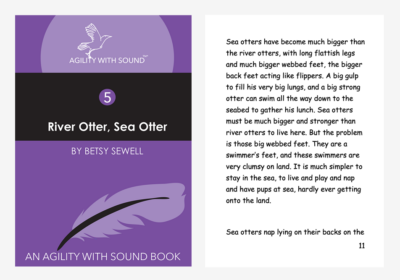
| River Otter, Sea Otter | Final blends, l-controlled vowels | N | 2611 | All/ S | 1 |
| A Jar of Jam | Final blends, double suffixes (erly) | F | 1137 | All | |
| Jin the Otter | Final blends, double suffixes (ering) | S 4* | 1576 | All | 1 |
| Getting to the Summit | Final blends, double suffixes (ingly) | F | 1395 | All/ S | |
| Whiskers Black | Final blends, double suffixes (ened) | S 5* | 2508 | All/ S | 2 |
1* About the ubiquitous paddle crab, as told by one of their number.
2* The life cycle of salmon, with a particular focus on their need to navigate up and down rivers. What happens when there is one or more hydro dams on the river? The story follows the life of one female salmon.
3* These two books are about logging virgin forest in early Canada, and then the challenges of floating the logs down the river to the mill. Told as excerpts from a diary of one of the men involved.
4* Jin the Otter escaped from the Auckland Zoo in 2006. This is an account of her capture, exaggerated in parts.
5* Whiskers Black is fictional, but his story is typical of the many swaggers who walked the rural roads of New Zealand and Australia in depression times, seeking farm work, usually in return for food and a spot in a barn to sleep. A forgotten part of our history.
Level 5 writing
These books are all on themes suitable for students in years 5 – 10. Inferencing becomes yet more sophisticated. Lead/topic sentences are still provided for each paragraph, but students are expected to generate their own concluding sentences. Students are expected to use transition words effectively.
Whereas the lead sentence tells the reader what this paragraph is about, what the writer will be telling the reader, the concluding sentence summarises the main point made, what the writer has told the reader. Suggested concluding sentence starters are provided for each paragraph, but these are suggestions only. Students should be encouraged to generate their own.
Transition words are a key way to create cohesion and flow in writing. Their role is to make following the writer’s train of thought easy for the reader. They tell the reader how this new sentence or new paragraph is connected to the previous one. Students are introduced to transition words in The Sentence Book. Introduce this section before beginning this level and continue the exercises in tandem with the writing activities. The balance of specific practice with Sentence Book exercises and with the writing assignments will depend on the needs of your students.
Students who have a basic understanding of the role of paragraphs but need more sophisticated reading material could start here.
Focus on a_e, i_e. o_e;, ee, ea; ce
| Title | Phoneme | Fiction, Non-f, Non-f as story |
Word count | Senior, Junior, All | Writing |
| Nessy the Monster | a_e | F | 1328 | All/ S | 1 |
| The Quake | a_e | S 1* | 731 | All/ S | 1 |
| Mandy’s Problem | a_e, i_e | F | 374 | J | |
| The Snake Problem | a_e, i_e, o_e | F | 1058 | All | 1 |
| The Limpet | a_e, i_e, o_e | N | 1018 | All | 1 |
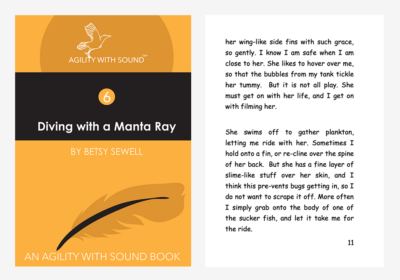
| Diving with a Manta Ray | a_e, i_e, o_e | S 2* | 2337 | All/ S | 2 |
| The Whale Stranding | a_e, i_e, o_e; triple initial blends | S 3* | 1390 | All | 1 |
| The Leaf Cutter Ants | ee, ea | N | 759 | All | |
| An Emerald Pendant | ee, ea; or, igh | F | 1847 | All/ S | 1 |
| Libby Riddles | ee, ea, or | N | 1717 | All/ S | 1 |
| Taking Control of the Nile | ee, ea, or | S 4* | 1868 | All/ S | |
| Hitler and his Beetle | ee, ea, or; basic prefixes | N | 1408 | S | 1 |
| Rin Tin Tin | ee, ea, war words | N | 1425 | All/ S | |
| Gold | ee, ea, or; basic prefixes | S 5* | 1404 | All/ S | 1 |
| The Glider | ee, ea, or; basic prefixes | N | 2362 | S | 1 |
| Shark Attack | ee, ea, or; basic prefixes | S 6* | 1858 | S | |
| A Runaway’s Tale | ee, ea, or; basic prefixes | S 7* | 2521 | S | 2 |
| Ice Cream | ee, ea, or; basic prefixes | N | 2622 | S |
1* How an earthquake can alter the landscape, sometimes dramatically, as told by confused trampers.
2* About manta rays but told by a diver who rescues a ray from a tangle of fishing net. The ray allows the narrator to ride on her back, follow her day, as rescued mantas really do.
3* A true account of one whale stranding but told through fictional characters.
4* The advantages and significant disadvantages of damming the Nile in Egypt, as told by three fictional characters who explain the various impacts on them.
5*A true account of gold mining in Central Otago, but the characters are fictional.
6* This is about the porbeagle shark, what is known about it, and what scientists have yet to learn. That part is non-fiction. Fictional scientists are on a mission to discover what they can, but the data suggests that much of what they believe is incorrect. The readers know something that the scientists do not; students must sort out the confusion. A lesson in scientific methodology.
7* The story of this runaway slave is largely, but not completely, based on a true story. The book explains the condition of slaves in southern U.S states.
Level 6 writing
Books at this level are basic decoding. Most are non-fiction and are on themes suited to students in years 5 – 10; those marked S only are on sophisticated themes and recommended for intermediate and secondary students only.. The inferencing component is heavily emphasised. The writing assignments teach the most sophisticated elements of writing, and appropriate for students in years 7 – 10 only. (Less demanding writing assignments are in production).
The writing assignments teach the most sophisticated elements of writing. Students are introduced to analysis, and to further cohesive devices, both within and between paragraphs.
Paragraphs now have four components. Students are now required to write their own lead/ topic sentence. Evidence and examples come next, generally the facts of the case. This is followed by analysis, making sure that the reader follows your argument, and ‘gets’ the relevance of this evidence. The final sentence summarises this paragraph, and students now learn techniques for linking one paragraph to the next, to segue (pronounced seg-way).
Books labelled ‘all’ are suitable for year 5 and 6 students. The writing assignments are generally too advanced for these students. A less demanding writing assignment is in production.
The analysis component should answer the following:
Why is this important?
Why does this matter?
How is this evidence relevant to the main point you are making, in this paragraph and in the whole essay?
What are my readers supposed to be thinking or feeling now?
Make sure they are thinking what you want them to think. This can all be summarized in two words: So what?
These two words appear at the beginning of this section of every body paragraph. This should mean that nothing is left to chance, that the readers follow the argument easily, and are left convinced by what they have been told. There should be no space for the reader to become lost, confused, skeptical or unconvinced.
Cohesion
Students should, by now, be very adept at using transition words to link sentences. They are now introduced to other techniques, most especially the ‘Known before New Contract’. This means a sentence begins with a previously introduced thought, and then the new information is added. This technique is discussed in The Sentence Book, on p. 79.
Students are also introduced to ‘pointer words’, most especially this, that, these and those, and their role in linking sentences. It is easy to overdo transition words.
Students should be encouraged to use a mix of these cohesive devices within a paragraph.
Focus on vowel digraphs
| Title | Phoneme | Fiction, Non-f, Non-f as story |
Word count | Senior, Junior, All | Writing |
| The Stingray | ai | N | 561 | All | |
| Adrift with a Shark | ai, oa | F | 2939 | All/ S | 1 |
| Pink Candles | ai, | S 1* | 2041 | All/ S | 1 |
| Uncle Max’s Big Problem | oa, ai | F | 354 | J | |
| My Holiday | ai, oa, oo | F | 2158 | All | |
| Catching Flying Fish | tch | N | 728 | All | |
| The Beaver | dge | N | 1455 | All/ S | 1 |
| The Christmas Truce | u_e, are, ire | S 2* | 1582 | All/ S | 1 |
| The Humpback Whale | ou | N | 1068 | All/ S | |
|
The Runner |
ou | N | 1682 | All/ S | 2 |
| Living in a Yurt | ur | N | 1368 | All | |
|
The First All Blacks |
ur, ir, ear as in earth | N | 1512 | All/ S | 1 |
| Turtles in Peril | ai, oa, oo, ou, ir, ur, tch, dge | N | 1692 | All/ S | 2 |
| The Elephant Problem | o as u, as in money | N | 943 | All/ S | 1 |
| This Life of Mine | r-controlled vowels, incl air, ear etc | N | 2542 | All/ S | |
|
The Hunter and the Bear |
r-controlled vowels, incl air, ear etc | S 3* | 2871 | All/ S | 1 |
|
The End of the War |
ew | N | 1056 | All | |
|
Fast and Slow |
ew, aw | N | 1416 | All | 1 |
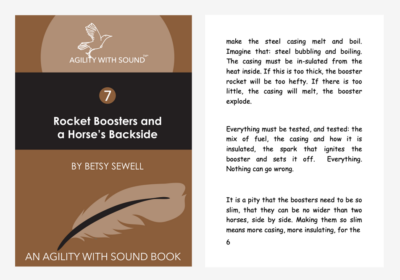
| Rocket Boosters and a Horse’s Backside | au, oi, ow as in town, simple prefixes | F | 1667 | All/ S | 1 |
1* A true account of conditions in coal mines in the early 1800s, when candles were used to light the mines. The characters and their specific challenges are fictional.
2* Allied and German soldiers called a truce on Christmas Day in WW1, with events as described in this story. Written as a letter home by one allied soldier, the letter was begun before the truce and completed after it. This soldier’s thoughts are fictional.
3* An account of grizzly bear lifestyle and behaviour, as told by a hunter who experienced an all-too-close encounter.
Level 7 writing
Books at this level are basic decoding. Most are non-fiction and are on themes suited to students in years 5 – 10. The inferencing component is heavily emphasised. The writing assignments teach the most sophisticated elements of writing, and appropriate for students in years 7 – 10 only. (Less demanding wring assignments are in production).
Students are introduced to analysis, and to further cohesive devices, both within and between paragraphs. Paragraphs now have four components. Students are now required to write their own lead/ topic sentence. Evidence and examples come next, generally the facts of the case. This is followed by analysis, making sure that the reader follows your argument, and ‘gets’ the relevance of this evidence. The final sentence summarises this paragraph, and students now learn techniques for linking one paragraph to the next, to segue (pronounced seg-way).
The analysis component should answer the following:
Why is this important?
Why does this matter?
How is this evidence relevant to the main point you are making, in this paragraph and in the whole essay?
What are my readers supposed to be thinking or feeling now?
Make sure they are thinking what you want them to think. This can all be summarized in two words: So what?
These two words appear at the beginning of this section of every body paragraph. This should mean that nothing is left to chance, that the readers follow the argument easily, and are left convinced by what they have been told. There should be no space for the reader to become lost, confused, skeptical or unconvinced.
Cohesion
Students should, by now, be very adept at using transition words to link sentences. They are now introduced to other techniques, most especially the ‘Known before New Contract’. This means a sentence begins with a previously introduced thought, and then the new information is added. This technique is discussed in The Sentence Book, on p. 79.
Students are also introduced to ‘pointer words’, most especially this, that, these and those, and their role in linking sentences. It is easy to overdo transition words.
Students should be encouraged to use a mix of these cohesive devices within a paragraph.
Segue (pronounced Segway)
This was originally a musical term, referring to a piece of music, perhaps a tune, seamlessly turning into a different tune without a break, linked by a few notes or bars in common. The transition is smooth, barely perceptible, accomplished without a pause, with no interruption. Some students will almost certainly be able to offer examples, but failing that, this very brief video demonstrates segue with two ‘The Sound of Music’ clips:
In writing, segue means the same thing. It may mean that a few words in the concluding sentence hint at the theme of the following paragraph, seamlessly linking the ideas. “In summary, …, but there is a second, possibly better, option.” “In brief,…, although this is not always the case.” “Clearly, …, but in practice there are pitfalls to this approach.” This tells the reader what the next paragraph is likely to be about.
Starting the following paragraph with a transition word has the same effect. “However,…” tells the reader that they are about to learn a different point of view. “In addition, …” tells them something else.
Students should be encouraged to use a mix of these techniques. It is not always possible or practical to segue from one paragraph to the next, but where feasible, this smooth flow from one idea to the next makes comprehending the passage so much easier.